


Climb Mount Kilimanjaro via the Rongai route can be a success with the inclusion of a 7 Day wildlife safari. With this itinerary, 14 Days Mount Kilimanjaro and Wildlife Safari are split into
two equal duration ( 7 Days Rongai Route for Mount Kilimanjaro climb and 7 days wildlife safaris. ). With the wildlife safaris you also get to explore the best of Tanzania’s Northern circuit
national parks like the Lake Manyara, Tarangire, Ngorongoro and the Serengeti National Parks.
Day 1: Arrive in Arusha
Arrival at Kilimanjaro airport for the 14 Days Kilimanjaro Climb and Wildlife Safari, you will be welcomed by our mountain guide who will usher you into a waiting vehicle and transfer you
to outpost lodge in Arusha . Our tour coordinator will have a short climb briefing session with you at the Hotel and leave you to relax at Hotel (bb) booked. We will gather in the evening for a
pre-climb briefing and an equipment check.
Day 2: Rongai Start Point (1996m) – Simba camp (2626m)
Hiking time: 4 hours
Distance: Approximately 6.7 km
Habitat: Forest (Montane)
Depart from your hotel to the Marangu park gate for registration. From Marangu park gate we travel to Naro Moru, north east Kilimanjaro, a further 68km and approximately 2 ½ hours on bad
roads to the Rongai start point (1996m). Meet your guide and porters before you begin your hike from the Nale Moru village. The small winding path crosses maize fields before entering pine
forest, and then climbs gently through a forest. The trail is not at all steep, but is rather a gentle hike through a beautiful country side. The first night’s camp is at Simba Camp (2 626m). The
camp facilities include a public toilet and a wooden table with benches, but no hut.
Day 3: Simba camp (2626m) – Kikelewa Camp (3679m)
Hiking time: 6 – 7 hours
Distance: Approximately 11.8 km
Habitat: Moorlands
We hike from Simba camp up towards Kibo till 3 482m for lunch at First Caves, a distance of 5.8km. After lunch we continue trekking until reaching Kikelewa Camp at about 3679 metres.The views start to open up and you begin to feel you’re on a really big mountain! Water can be found in a obvious stream below the cave, although you might have to wander downhill a way to find a pool or two. Enjoy dinner and overnight at Kikelewa camp.
Day 4: Kikelewa Cave (3679m) – Mawenzi Tarn camp (4303m)
Hiking time: 3 hours
Distance: Approximately 3.7 km
Habitat: Moorlands
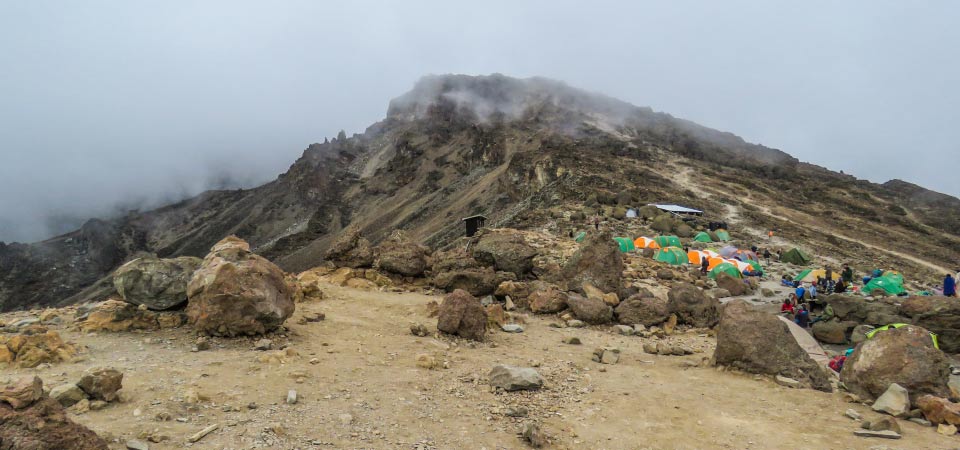
A short but steep climb up grassy slopes offers superb views of this wilderness area. The vegetation zone ends shortly before you reach your next camp at Mawenzi Tarn spectacularly situated beneath the towering spires of Mawenzi. Spend the afternoon acclimatizing and exploring the area.
Day 5: Mawenzi Tarn camp (4303m) – Kibo hut (4730m)
Hiking time: 5 hours
Distance: Approximately 9 km
Habitat: Alpine desert
After breakfast we head west and continue ascending on the east side of Kibo crossing the saddle between Mawenzi and Kibo taking 4 to 5 hours to reach Kibo Hut. The remainder of the day is
spent resting in preparation for the final ascent, which begins around midnight. Overnight at Kibo hut.
Day 6: Summit attempt Kibo hut (4730m) – Uhuru Peak (5895m) – Horombo hut (3705m)
Hiking time: 7 to 8 hours to reach Uhuru Peak, 6 to 8 hours to descend to Horombo
Distance: Approximately 5.4km ascent and 15 km descent
Habitat: Stone scree / ice-cap summit
You will rise around 23h20, and after some tea and biscuits you shuffle off into the night, and this is where the going really gets tough. The first section of the trail consists of a rocky path to
the Hans Meyer Cave (5150m), also a good resting spot.The path then zigzags up to Gillman’s point (5 681m), which is located on the crater rim. This section is very steep with a lot of stone scree, requiring a great physical and mental effort. This is probably the most demanding section of the entire route. Do the Kili shuffle and move slowly.From Gillmans Point you will normally encounter snow all the way up to Uhuru peak (5895m),the highest point in Africa.Total exhilaration and satisfaction – you made it Weather conditions on the summit will determine how long you will be able to spend, taking
photographs, before the 3 hour descent back to Kibo hut. After a short rest at Kibo hot, you gather all your gear you left behind for the ascent and head down to Horombo hut (3 hours) for
your overnight. The return to Horombo hut will seem surprisingly fast compared to the ascent.The total time spent walking on this day is around 14 hours, so be prepared for a very tough day.
Later in the evening you enjoy your last dinner (with soft drinks and beer for sale at the camp office) on the mountain and a well-earned sleep, filled with memories and stirring emotions.
Day 7: Horombo hut (3705m) – Marangu Gate (1860m)
Hiking time: 6 hours
Distance: Approximately 19.7 km
Habitat: Moorland & Montane Forest
After breakfast you continue your descent (6 hours), passing the Mandara hut, down to the Marangu gate. It is strongly recommended not to pay your porters any tips until you and all your gear have reached the gate safely. At Marangu gate you sign your name and details in a register. This is also where successful climbers receive their summit certificates. Those climbers who reached Gillman’s Point (5685m) are issued with green certificates and those who reached Uhuru Peak (5895m), receive gold certificates.You now drive back to town for a long overdue hot shower, dinner descent bed and
celebrations!!
Day 8: Full Day Game View Tarangire National Park
After breakfast you continue to explore the Tarangire National Park which is the third largest national park in Tanzania. This day you will spend full day of game drives in this fabulous
national park highlighted with the gigantic baobab trees and abnormally large herds of elephants. At Tarangire you will have the chance to sight the rare Oryx, and other animals’ likes of zebras,
giraffes, warthogs, leopards, cheetahs etc. The Tarangire River which is the life blood of this national park ensures a year round supply of water and the river beds takes center stage when
animals gather to get this rare commodity resulting into magnificent wildlife actions when the predators try to grab a meal taking advantage of the moment. Later in the evening you will drive
to Tarangire safari lodge
Day 9: Arusha to Lake Manyara National Park
After breakfast at your hotel we will meet and drive to Lake Manyara National Park, although small in size, this park is one of the most diverse reserves in the country. Lake Manyara covers
two thirds of the park. At the backdrop is the wall of the Great Rift Valley, before which lies the ground water forest, areas of open grassland near the lake foreshore, and the Soda Lake. We
enjoy a picnic lunch in this area, which consists of open grassy areas, hot springs, dense woodlands and steep mountainsides. Lake Manyara National Park is a birding paradise that has
more than 350 species of bird. The park is also famed for its unique and elusive tree- climbing lions. Overnight at Ngorongoro farm House
Day 10: Manyara to Serengeti
After breakfast depart 07:30 for Serengeti passing through Olduvai Gorge, the site of the Leakey family discovery of fossils 50 km long and in some places 90 metres deep. It drains the slopes of
the nearby mountains plus of human and animal ancestors dating back to almost two million years. Olduvai Gorge is a canyon carved by water through the southern part of the Serengeti
Plain. The gorge is about the Serengeti Plain. Its chief claim to fame is the rich treasure-trove of human and animal fossils that it has yielded. Meals and overnight at Kati kati tented camp
Day 11 & 12: Full day in Serengeti Park this day after breakfast at 07:00 we will take your packed lunch for a full day game drives in the wilderness tracking the Great migration trails. Thorough explanation about this great world event that Tanzania proud of will be provided. And in the evening as the sun goes down, drive back to the for dinner and overnight Meals and overnight Serengeti Kati kati tented camp
Day 13: Full Day, Ngorongoro Crater
Today we start very early at 07:00 am, with a packed picnic lunchbox, for the game drive inside the Ngorongoro Crater. As very few animals migrate in and out of the crater with its 2000 ft.
high walls, a population of approximately 25,000 large animals can be seen. This is reputedly the highest density of mammalian predators in Africa. The crater has the highest known population
of mountain reedbuck, zebra, gazelle and wildebeest. It is also known for the big five rhino, lion,leopard, elephant, and buffalo. Your driver/guide will be in contact with other safari drivers and
will amaze you with his skill at locating hidden animals. The birdlife is prolific here and up to a 100 species can be seen in one day. In the middle of the crater there is a large lake inhabited by
hundreds of flamingos and from a distance appears as a pink border around the lake. With late afternoon approaching, while the east African sunset colors take your breath away, we will be
leaving the Ngorongoro Crater and heading Ngorongoro Rhino Lodge
Day 14: Departure Day
After nicely breakfast we will provide Private departure transfer which is included from Arusha to Kilimanjaro International Airport (JRO) for your flight ,unless you have an option to have
Safari or any other option we will discuss.
Related Tour Packages
Send us Free Quote.
[fc id=’1′][/fc]





 Trusted Partner